企業進出 / 投資 / 生活情報
International Column
Is Osaka a Promising Market for Real Estate Investment?
Japan
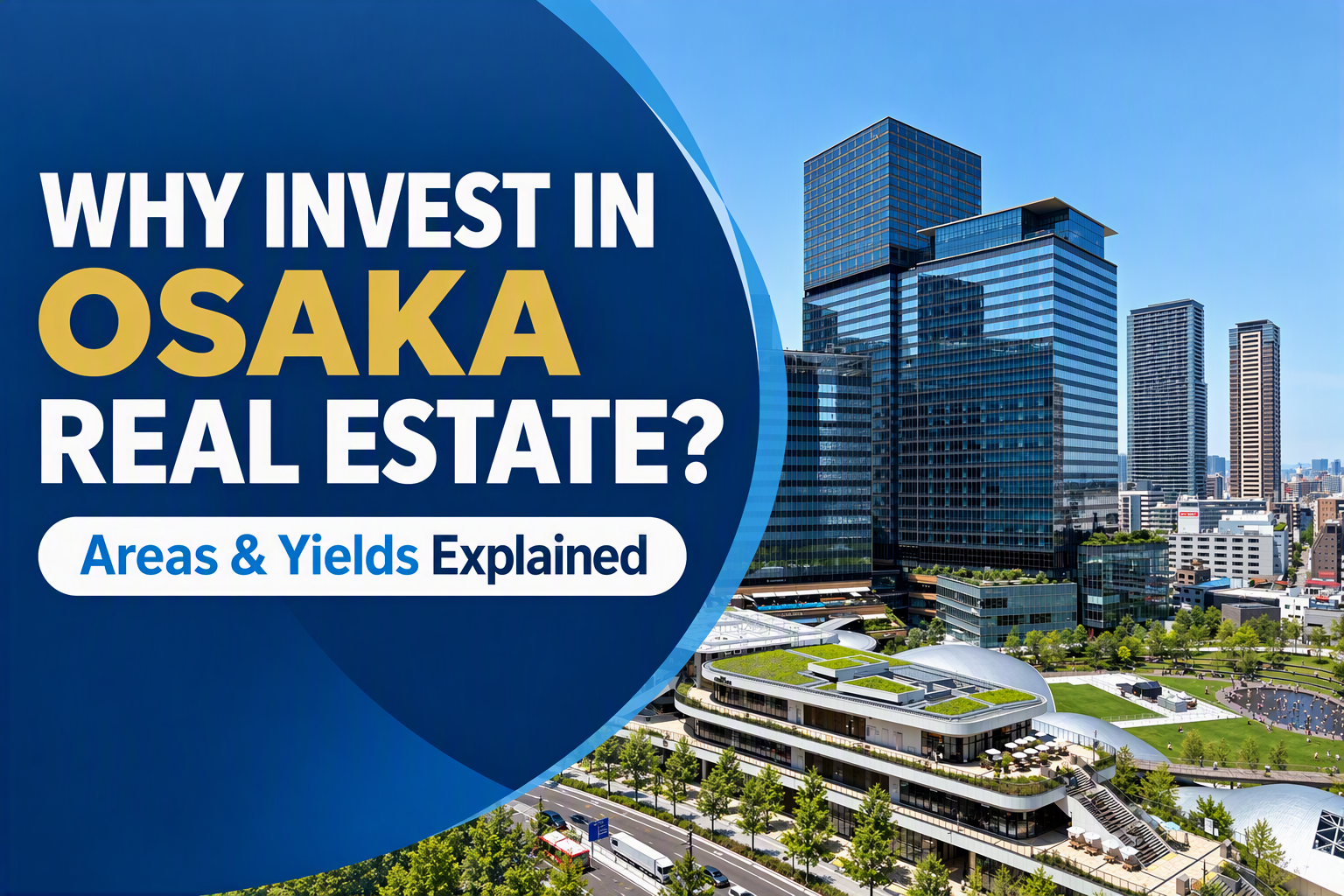
Is Osaka a Promising Market for Real Estate Investment?
When considering real estate investment in Osaka, many investors wonder, “How do rental yields compare with Tokyo?” and “Which areas offer the strongest growth potential for the future?”
In recent years, Osaka has attracted growing attention from both domestic and international investors, driven by large-scale redevelopment projects such as the Umekita district, the Yumeshima Integrated Resort (IR) development, and extensive infrastructure improvements associated with Expo 2025 Osaka, Kansai. At the same time, as with any real estate investment, factors such as vacancy risk and natural disaster risk should not be overlooked. Making informed investment decisions requires a thorough understanding of the characteristics of each area and property.
According to the data referenced in this article, Osaka generally offers higher expected yields than Tokyo. However, investment performance can vary significantly depending on the property type, location, and market conditions at the time of purchase.
This article, based on interviews with and supervision by specialists from the Starts Kansai Asset Sales Department, explores the differences in property prices and yields between Osaka and Tokyo, highlights recommended investment areas, examines future growth prospects, outlines key risks to consider, and explains important points regarding property selection, management, and eventual resale.
In the latter half of the article, we will also share insights from the International Business Division of Starts Corporation, which supports overseas investors, highlighting key considerations for those looking to invest in real estate in Osaka.
Q1:Are real estate investment yields in Osaka higher than in Tokyo?
According to a survey by the Japan Real Estate Institute, the expected yields assumed by investors at acquisition are higher in Osaka than in Tokyo. However, property prices and actual yields differ depending on location, property characteristics, and timing.
Differences in property prices and expected yields between Tokyo and Osaka
Price comparisons can vary significantly depending on the target area and property type. The following comparison therefore focuses on the expected yields assumed by investors when acquiring a property.
In the 54th Japanese Real Estate Investor Survey, as of April 2026, published by the Japan Real Estate Institute, Osaka exceeded Tokyo in the following expected-yield categories.
| Property Type | Osaka | Tokyo |
|---|---|---|
| Studio apartment | 4.2% | 3.6%(Jonan) |
| Family-type apartment | 4.3% | 3.7%(Jonan) |
| Class A office building | 4.1%(Midosuji)/4.0%(Umeda) | 3.2%(Marunouchi / Otemachi) |
These results show that expected yields in Osaka are higher than in Tokyo’s Jonan area. Actual profitability, however, differs by property and timing, so each investment should be assessed individually.
Q2: Which areas should investors consider in Osaka?
In recent years, Osaka has attracted strong interest from both domestic and international investors, supported by major redevelopment projects such as Umekita, the Yumeshima IR development, and infrastructure improvements related to Expo 2025 Osaka, Kansai. However, successful real estate investment requires careful consideration of factors such as vacancy risk, disaster risk, and the characteristics of each area and property.
Data referenced in this article suggests that Osaka generally offers higher yields than Tokyo, although returns vary depending on the property, location, and market conditions.
This article, based on insights from the Starts Kansai Asset Sales Department, explains the differences in prices and yields between Osaka and Tokyo, recommended investment areas, future growth potential, key risks, and important points for property acquisition and management.
In the latter half, we also share perspectives from the International Business Division of Starts Corporation, highlighting key considerations for overseas investors looking to enter the Osaka real estate market.
Characteristics of central Osaka, including Kita and Chuo Wards
Umeda, Hommachi, and Yodoyabashi contain major office and commercial districts and offer convenient transportation. For residential investment, investors should examine property-specific demand from office workers and single-person households that value commuting convenience.
According to the 2026 Official Land Price publication, the average residential land price was JPY 622,200 per square metre in Kita Ward and JPY 772,700 per square metre in Chuo Ward. The respective average year-on-year increases were 9.2% and 8.4%.
Because central Osaka generally has high land values, investors should review not only the acquisition price but also projected rental income and yield.
According to a representative from the Starts Kansai Asset Sales Department, “The Hokusetsu area offers an excellent balance of residential comfort and transportation convenience, generating stable demand from families.” When evaluating an investment property, it is important to consider not only yield potential but also the area's ability to attract long-term residents.
Characteristics of suburban areas, including Toyonaka and Suita
Some areas in northern Osaka Prefecture, including Toyonaka and Suita, provide convenient access to central Osaka. When considering family-oriented properties, investors should review transportation, the surrounding living environment, floor plans, and prevailing rents.
Suita is served by five railway systems: JR, Hankyu, Kita-Osaka Kyuko, Osaka Metro, and the Osaka Monorail. Property-selection criteria differ from those in central Osaka, making it important to assess whether a property offers practical convenience for prospective tenants.
Q3:How could Umeda redevelopment and the opening of the Yumeshima IR affect Osaka real estate investment?
The development of Umekita Phase 2, known as Grand Green Osaka, and the Osaka IR being developed for an opening around autumn 2030 are important factors when considering future changes in visitor flows and demand for offices, retail space, and real estate. Their precise effects on future land prices and rental demand are not guaranteed.
Redevelopment around Umeda, including Umekita Phase 2
Development of Grand Green Osaka is progressing around Umeda. The advance opening took place in September 2024, followed by the opening of hotels, offices, and commercial facilities in the South Building in March 2025. The full district opening is scheduled for fiscal 2027.
Osaka City’s 2026 land-price materials state that development effects from Umekita Phase 2 and growth in tourism increased demand for retail and hotel sites, widening commercial land-price gains in areas including Kita Ward. Domestic and overseas investment demand for well-located condominium and office sites near stations in central Osaka also remained strong, contributing to upward land-price trends.
Potential impact of the Yumeshima IR
The Osaka IR, an integrated resort, is being developed on Yumeshima for an opening around autumn 2030. Plans include hotels, an international conference centre, exhibition facilities, dining, and entertainment. The project anticipates approximately 20 million visitors annually and employment of around 15,000 people at the IR facilities. Its annual economic impact on the Kinki region during operation is estimated at approximately JPY 1.14 trillion.
Because the project is expected to generate substantial visitor traffic and employment, it is one factor to monitor when assessing real estate demand in nearby areas. However, the degree of impact on land prices and rental demand remains uncertain. Investors should evaluate current rents, vacancy rates, and property prices rather than relying solely on expectations surrounding the IR.
According to a representative from the Starts Kansai Asset Sales Department, “The IR development is expected to enhance the visibility of Osaka as a whole and increase visitor traffic, not only in the Yumeshima area but across the city.” However, investment decisions should be based not only on future growth expectations but also on current rental demand and profitability.
Source:大阪市「うめきた(大阪駅北地区)プロジェクト」
Source:大阪市計画調整局「令和8年地価公示結果について(大阪市)」2・5ページ
Source:大阪府・大阪市 IR推進局「統合型リゾート 大阪IR」
Q4: What should investors be careful about when investing in Osaka real estate?
Investors should evaluate profitability after vacancy and management expenses, while also considering differences in housing demand by area and exposure to natural hazards. Those purchasing land to build studio apartments should also confirm whether the Osaka City guidelines apply.
Osaka City guidelines for studio apartment buildings
Osaka City has established guidelines governing building plans and management methods for collective housing containing studio-type units.
Under the guidelines, prior consultation may be required for the construction, extension, reconstruction, or relocation of a building containing multiple units, including studio-type units with an exclusive floor area of 35 square metres or less. Because procedures are required before applying for building confirmation, investors planning to purchase land and construct studio apartments should verify applicability and required measures before acquisition.
Differences in housing demand by area
The 2026 Official Land Price publication shows rising residential land prices in Osaka City and northern Osaka areas with strong transport and living convenience, while prices continue to decline in some less accessible locations.
According to a representative from the Starts Kansai Asset Sales Department, “Even within Osaka Prefecture, rental demand can vary significantly depending on factors such as proximity to stations and everyday convenience. Rather than judging an area by name alone, it is important to review actual leasing activity and the competitive landscape.”
When selecting a property, investors should consider factors such as walking distance to the nearest station, surrounding amenities, and nearby competing properties to assess tenant demand. It is also important to review population and household trends, as well as future housing demand, to minimize the risk of prolonged vacancies over the long term.
Checking natural-hazard risks on hazard maps
Real estate investment should also account for potential damage to buildings and equipment and associated repair costs following natural disasters. Osaka City identifies potential inundation from river flooding, inland flooding, storm surges, and tsunamis.
Flood damage may result not only in repair costs but also in periods when the property cannot be occupied, reducing rental income. Before purchase, investors should verify the property’s inundation zone and expected flood depth on hazard maps and consider the scope of fire and earthquake insurance coverage.
Source::大阪市「大阪市ワンルーム形式集合建築物に関する指導要綱に基づく事前協議」
Source::大阪市計画調整局「令和8年地価公示結果について(大阪市)」2ページ
Source::大阪市「“津波・水害から命を守るために”水害ハザードマップ」
Q5: What is important for successful real estate investment in Osaka?
Investors should consider not only the acquisition price and initial yield but also post-acquisition management and future resale. When the property is located far from the owner’s residence, the management method can significantly affect the owner’s workload and costs. Investors should determine before purchase who will manage the property and how.
Property management options
Management options include self-management by the owner and outsourcing to a property management company. For owners living outside Osaka, outsourcing may be practical because it can be difficult to respond promptly on site to tenant enquiries, equipment failures, or repairs.
When outsourcing, investors should confirm not only management fees but also the scope of services, including tenant relations and repairs. Long-term cash flow should be reviewed with management costs and operational workload included, rather than focusing solely on acquisition price and yield.
Why an exit strategy should be considered before purchase
A future sale should be considered from the acquisition stage. Resale liquidity and pricing are influenced by location, building age, property condition, and other factors.
Before purchase, investors should assess whether the area is likely to retain housing demand and whether future buyers would find the property attractive. Appropriate maintenance and repairs after acquisition are also important for preserving its condition. Cash-flow analysis should therefore include the future sale, not only the current yield.
Summary
Osaka continues to attract real estate investors, particularly in central areas such as Umeda, Honmachi, Shinsaibashi, and Namba. In recent years, districts such as Nishi Ward and Fukushima Ward have also gained attention for their balance of urban accessibility and residential appeal.
According to Starts’ Osaka team, investment inquiries are especially concentrated in Kita Ward and Chuo Ward, where strong rental demand is supported by tenants seeking convenient access to Umeda. As a result, areas such as Nishi Ward and Fukushima Ward are also being considered, depending on the property's characteristics and investment objectives.
At the same time, property prices in Osaka have been rising, and price appreciation does not always translate into higher investment returns. Rather than focusing solely on yield figures or an area's reputation, investors should evaluate actual rental demand, location quality, management costs, and future resale potential when making investment decisions.
Comments from Starts International Business Division
For many overseas investors, Tokyo is often the first city that comes to mind when considering real estate investment in Japan. In recent years, however, a growing number of investors have turned their attention to Osaka, attracted by its relatively affordable property prices, attractive yield potential, and ongoing redevelopment projects.
We frequently receive inquiries from overseas investors asking whether it is possible to own and manage Japanese real estate without residing in Japan, and how property management is handled after purchase. Successful real estate investment involves not only acquiring a property but also planning for long-term leasing, management, and eventual resale.
Starts International Division works closely with Starts Kansai to provide investment advice based on local market conditions and rental demand. By evaluating not only projected yields but also actual market demand and operational considerations, investors can make more informed and sustainable investment decisions.
Contact us
Starts Group provides end-to-end support for real estate investment in Japan, including property acquisition, leasing, management, and resale.
For overseas investors, the International Business Division of Starts Corporation offers multilingual support in English, Chinese, Korean, and Japanese. Together with Starts Kansai, we provide local market insights and investment advice for the Osaka area.
For more information, please visit the Starts Kansai website .
Whether you are considering your first investment in Japan or expanding your portfolio, our team is here to help.
Feel free to contact us for personalized guidance on Osaka real estate opportunities.
 土地活用・免震住宅